
2026 Business Advocacy
The Chamber advocates for business-friendly policy in support of private enterprise, entrepreneurial endeavors, and an economically competitive business climate through its 2026 Policy and Legislative agenda.
CURRENT ACTIVATIONS
LOCAL & REGIONAL

The Springfield Chamber submitted a letter to Springfield City Council regarding the procurement process for the City of Springfield’s City Hall Deferred Maintenance and Modernization Project.
The Chamber did not evaluate the technical merits of the procurement process, nor did it advocate for any particular contractor. Instead, the Chamber viewed the issue through a broader policy lens. If experienced local employers are consistently raising questions that could affect the long-term competitiveness of one of Springfield’s key industry sectors, those questions deserve consideration by the City’s elected leadership.
Chamber encourages broader review of public procurement process (6/30/26)
The City of Springfield has directed staff to design a payroll tax framework as part of its Fiscal Stability work, and the Springfield Chamber supports the currently proposed payroll tax structure as a short-term tool to help address the City’s budget deficit. For employers, payroll taxes directly affect labor costs and administrative complexity, especially when layered onto existing taxes. The Chamber is focused on ensuring strong guardrails, transparency, and administrative simplicity, while maintaining that long-term fiscal stability must be achieved through economic growth, business retention, and system-wide solutions.
Budget Forecast + Payroll Tax are the Focus of the Chamber’s April Roundtable (4/29/26)
City of Springfield Publishes FY27 Proposed Budget, Invites Public Review and Participation (4/21/26)
Payroll Tax Conversation Continues in Springfield (4/3/26)
Springfield Payroll Tax Work Moves Forward, Chamber Offers Perspective (12/9/25)
Advocacy in Action: Chamber Offers Perspective on City of Springfield Fiscal Strategy (12/4/25)
Springfield’s Fiscal Future: A Roundtable Conversation with the Mayor (7/28/25)
The Springfield Area Chamber of Commerce is urging Lane County leaders to preserve the original intent of Transient Lodging Tax (TLT) funding (also referred to as the Transient Room Tax, or TRT) as the County is considering a proposal that would reallocate a portion of unassigned lodging tax revenue in its proposed FY2026–2027 budget.
TLT Fund Distribution Proposal Sparks Chamber Testimony to Budget Committee [includes testimony] (5/7/26)
Springfield Chamber’s TRT Grant Services Report Highlights Visitor Experience [includes testimony] (2/24/25)
Transient Room Tax (TRT) Allocation the Subject of Springfield Chamber’s Latest Testimony [includes testimony] (3/12/24)
Springfield Chamber Submits Testimony on Best and Highest Use of Room Tax (TRT) Increase [includes testimony] (9/28/22)
Voters did not approve BM 20-373. The measure would have allowed any individual to file lawsuits on behalf of waterways and connected ecosystems, exposing businesses, nonprofits, and public agencies to significant legal liability for alleged or perceived environmental harm. For businesses, the measure would have created broad uncertainty and risk, enabling costly litigation tied to routine, lawful activities. The Springfield Chamber opposed this measure and joined a growing coalition of employers and community partners concerned about its legal, economic, and fiscal impacts.
Chamber Submits Testimony Supporting Proposed Springfield Development Code Amendments [includes testimony] (5/19/26)
STATEWIDE
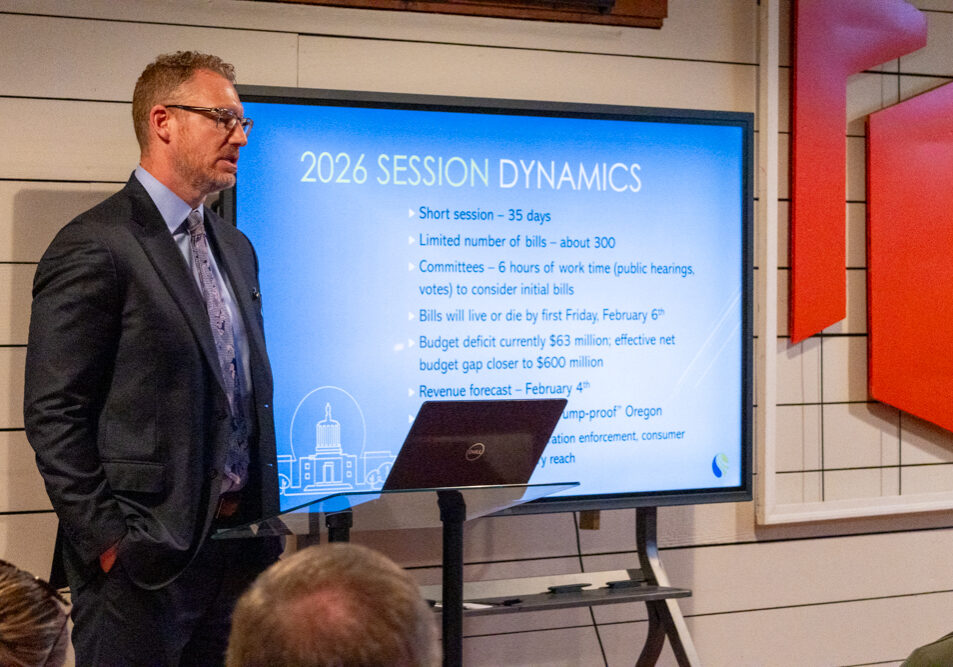
The Springfield Area Chamber of Commerce President & CEO Vonnie Mikkelsen joined U.S. Senator Jeff Merkley for a roundtable discussion focused on affordability and economic pressures facing Oregon families and businesses. During the conversation, Mikkelsen emphasized that affordability isn’t just a household budget issue; it has become a workforce and small business sustainability issue.
Chambers share business perspective during affordability roundtable with Sen. Merkley (6/8/26)
The Springfield Area Chamber of Commerce submitted input to Governor Tina Kotek’s Prosperity Council, outlining what they are hearing directly from the business community. The message is as clear as it’s ever been: Oregon’s long-term economic success depends on improving two interconnected areas, our business climate and our workforce pipeline.
After the Prosperity Council released a comprehensive economic report, the Springfield Chamber submitted a joint letter to Governor Kotek and members of the legislature in collaboration with the Oregon State Chamber of Commerce, Oregon Business Institute, and chambers of commerce from across the state. The letter urged state leaders to act quickly on the Council’s findings and begin developing substantive reforms.
Oregon Prosperity Council: Springfield Chamber Shares Business Community Voice (3/23/26)
Governor's Prosperity Council echoes local business voices (7/28/26)
- SB 1586: Oregon JOBS Act
- HB 4071: Liability Waivers
- SB 1517: Liability Waivers (Ski only)
- HB 4084: Governor’s Prosperity Roadmap
- HB 4073: Regulatory Fiscal Impact and Transparency
- SB 1566: Prevailing Wage Exemptions (housing projects)
- HB 4108: Annexation
- HB 4102: Expedited regulatory review (DEQ 3rd parties)
CLICK HERE for full descriptions of these bills.
- HB 4148 / SB 1562: Transient Lodging Tax Diversion
- HB 4134: Statewide TLT Increase
- HB 4015: Federal Tax Code Disconnection
- HB 4098: Insurance Unlawful Trade Practices
- SB 1507: Retail Sales Tax
- SB 1505: Labor Standards Board
- HB 4094: PTO Payout
- SB 1511: Increase to estate tax rate
- HB 4089: Criminal penalties for wage claims
CLICK HERE for full descriptions of these bills.
FEDERAL
The Springfield Area Chamber of Commerce has joined more than 400 state and local chambers of commerce from all 50 states in urging Congress to advance the BUILD America 250 Act (H.R. 8870), a bipartisan proposal to reauthorize and strengthen national infrastructure programs through 2031.
Springfield Chamber joins national coalition supporting BUILD America 250 Act (5/14/26)
Read the coalition's joint letter (5/14/26)
The Springfield Area Chamber of Commerce supports bipartisan, comprehensive federal permitting reform to modernize an outdated system that delays critical infrastructure and economic development projects across the country. The Chamber has joined a national coalition urging Congress to act quickly on durable permitting reforms that provide certainty, reduce delays, and unlock economic growth.
Springfield Chamber supports bipartisan federal permitting reform (1/29/26)
2026 AGENDA
The Springfield Chamber’s 2026 Legislative and Policy Agenda has been developed to provide a structured framework for our advocacy efforts in local, state and federal issues. This agenda reflects our chamber’s ongoing commitment to fostering a pro-business environment, supporting economic competitiveness, and engaging strategically on policy issues that impact our members.
This agenda is informed by:
- Our board-adopted Economic Development and Business Advocacy Guiding Principles.
- Input from Chamber members, the Leaders Advisory, and key industry partners.
- Insights from the Oregon State Chamber of Commerce (OSCC) and Oregon Business & Industry (OBI).
- The Chamber’s annual Business Climate Survey (view 2024 here ; view 2025 here).
This policy agenda provides a framework, adopted by the Springfield Chamber Board of Directors, for our 2026 local, regional, and national legislative priorities. For information on specific bills the Chamber is engaging on, continue to refer to this page and stay engaged on the Advocacy section of our news site, The Bottom Line, as issues emerge and develop over the course of the legislative session and elections.
The Springfield Chamber's leaders advisory and staff will:
- Actively track legislation and engage with policymakers.
- Inform our members about the issues through communication and program platforms; and
- Mobilize members to support or oppose key policy efforts as necessary.
POLICY FRAMEWORK
We support tax policies that stimulate economic growth, competitiveness, and long-term fiscal stability, while avoiding disproportionate impacts on businesses, employees, or individual industry sectors.
- Support comprehensive statewide tax reform
- Support tax structures that are transparent, predictable, and broadly applied
- Oppose industry-specific or consumption-based taxes
- Oppose or closely scrutinize tax policy changes that increase administrative complexity or compliance burden for businesses
- Support revenue approaches that reinvest in economic development, infrastructure, and essential public services
We support policies and tools that attract, retain, and expand private investment by ensuring sites, infrastructure, and incentive programs are competitive, predictable, and aligned with long-term economic growth.
- Support business retention and expansion efforts
- Support site readiness initiatives that improve the availability of buildable land and facilities
- Support economic development incentives and tools that enable major capital investment
- Support innovation, modernization, and productivity investments
- Oppose regulatory barriers that discourage private investment or reinvestment
We support public investments and regulatory frameworks that enable workforce mobility, economic connectivity, and long-term system resiliency, while opposing cost and regulatory structures that hinder growth or competitiveness.
- Support transportation and utility investments that improve mobility and reliability
- Support transparent and predictable infrastructure funding and cost-recovery frameworks
- Support land-use and development policies that enable redevelopment and expand buildable land supply, including UGB flexibility
- Oppose mandates or funding mechanisms that prevent investment or housing production
We support workforce and talent development policies that expand participation, align education and training with employer needs, and ensure long-term institutional and economic sustainability.
- Support workforce and talent development systems aligned with employer and regional needs
- Support policies that expand workforce participation and strengthen skill pipelines
- Support reforms that improve the financial sustainability of workforce institutions
- Oppose workforce mandates or labor policies that impose excessive costs on employers
We support legal and regulatory frameworks that provide clarity, consistency, and reasonable limits on liability, ensuring businesses can operate, insure, and invest without exposure to excessive or undefined legal risk.
- Support reasonable limits on business liability
- Support reforms that improve access to affordable insurance
- Oppose policies that expand or create broad, undefined liability in ways that undermine insurability or investment
- Monitor emerging legal and regulatory proposals that increase litigation risk
We support environmental and energy policies that advance sustainability goals while maintaining economic competitiveness and recognizing the practical realities facing businesses.
- Support flexible regulatory frameworks that reflect industry realities
- Support innovation, technology adoption, and market-based approaches to environmental improvement
- Oppose regulatory approaches that impose excessive costs or uncertainty and evaluate emerging proposals for feasibility and impact